Seminole fashion
Two makers, forty years apart
Ruby Billie and Danielle Nelson offer two points of entry into a living fashion tradition.
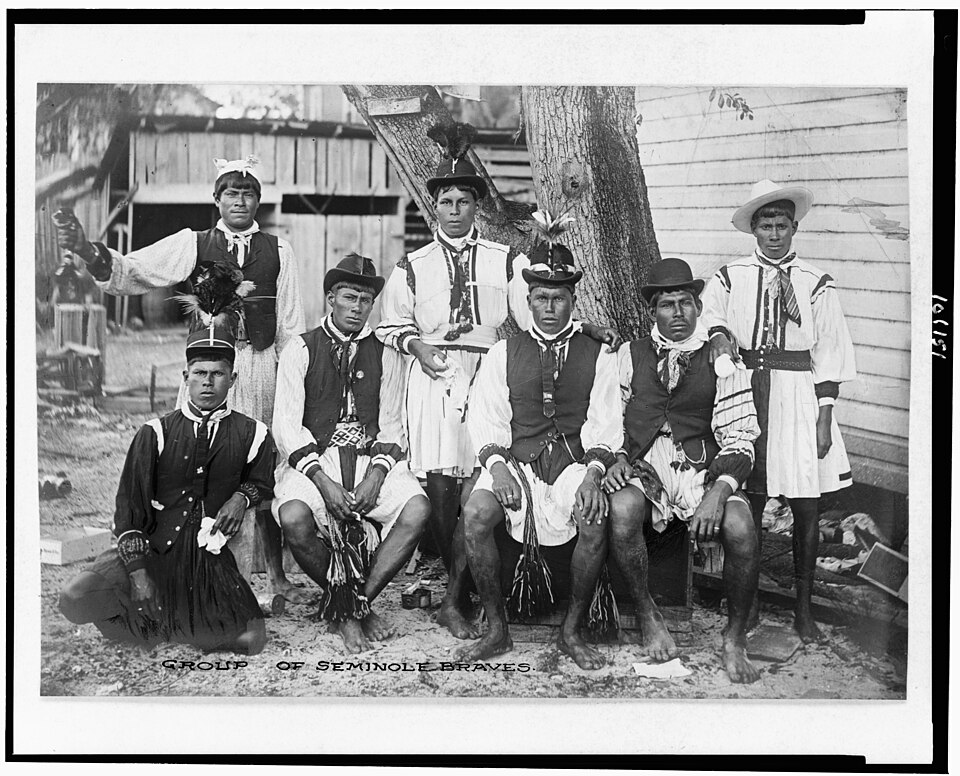 Historical group portrait of Seminole men. Library of Congress · Public domain
A search for a Seminole skirt and cape turns up two museum records with almost the same title. Open them together and the title starts to seem like the least interesting thing about either one. Ruby Billie made her ensemble in 1970. Danielle Nelson made hers in 2011–2012. Putting the makers’ names back into the conversation gives each piece a time and a person.
The materials lists reward a second look. Billie’s includes lace and rickrack, the trim with a zigzag edge. Nelson’s includes cotton tape and an elastic band. Think about the difference between an edge you can see from across the room and a band you might only notice while getting dressed. Both belong to the design. Looking for decisions like these leaves room for individual taste across generations, even when two garments share a name.
Rebecca Fell, writing for the Seminole Tribe of Florida’s Ah-Tah-Thi-Ki Museum, describes a collection broad enough to trace which patchwork fashions changed and which endured. That is a good invitation to explore the museum on its own terms. An occasion or ceremonial meaning needs its own evidence. Here the records give us something more immediate to appreciate: two named designers, their materials, and forty years of fashion history between them.