Korea / Florida
What can a seam carry?
A Korean wrapping cloth and a skirt by Maggie Buster put a familiar sewing technique to different uses.
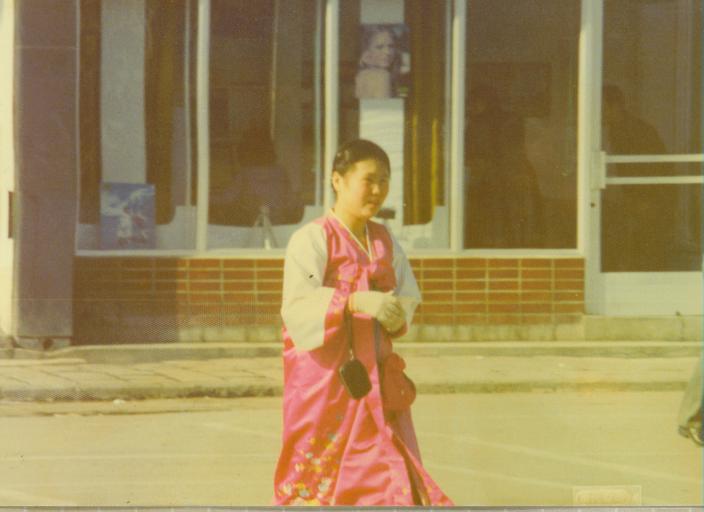 Korean dress in Seoul, 1978–79. Bob Simpson · CC BY 2.0
Imagine folding a square of cloth around a box. A seam that ran straight across the table a moment ago turns a corner and disappears underneath. That small change is a good way into jogakbo (조각보), a Korean wrapping cloth pieced together from smaller bits of fabric. The Metropolitan Museum of Art places its modern example in a tradition practiced by women across social classes in the late Joseon period. What looks like a finished composition laid flat still has a job to do once somebody picks it up.
Now open the Smithsonian record for a skirt by Maggie Buster, whom the museum identifies as Miccosukee Seminole (Mikasuki). The materials are cotton cloth and rickrack, a wavy trim. Picture how differently seams behave on a person walking than on a parcel tucked under an arm. One cloth folds around an object; the other takes its shape from a body in motion. Seeing them side by side makes the word “patchwork” feel like the beginning of a description.
There is also a difference in what the labels let us know. The Met describes a history of creative thrift for Korean wrapping cloths. Buster’s skirt comes with her name and a record of its collection directly from her in 1965. Carrying the Korean explanation over to her skirt would turn a guess about her materials into a claim about her intentions. A better first question is a simpler one: what did this particular maker choose to do with a seam?